Visiting Antigua Guatemala at any time of the year is always a good idea. But if you are curious and appreciate cultural and religious festivities, even if you are not a religious devout, Semana Santa -Holy Week- is a great time to visit this little colonial city. Like in many religions worldwide, Catholic celebrations in Latin America are celebrated with colour, fervour, and tradition.
Holy Week takes place during the week before Easter Sunday, commemorating the Passion, Crucifixion, and Resurrection of Jesus Christ.
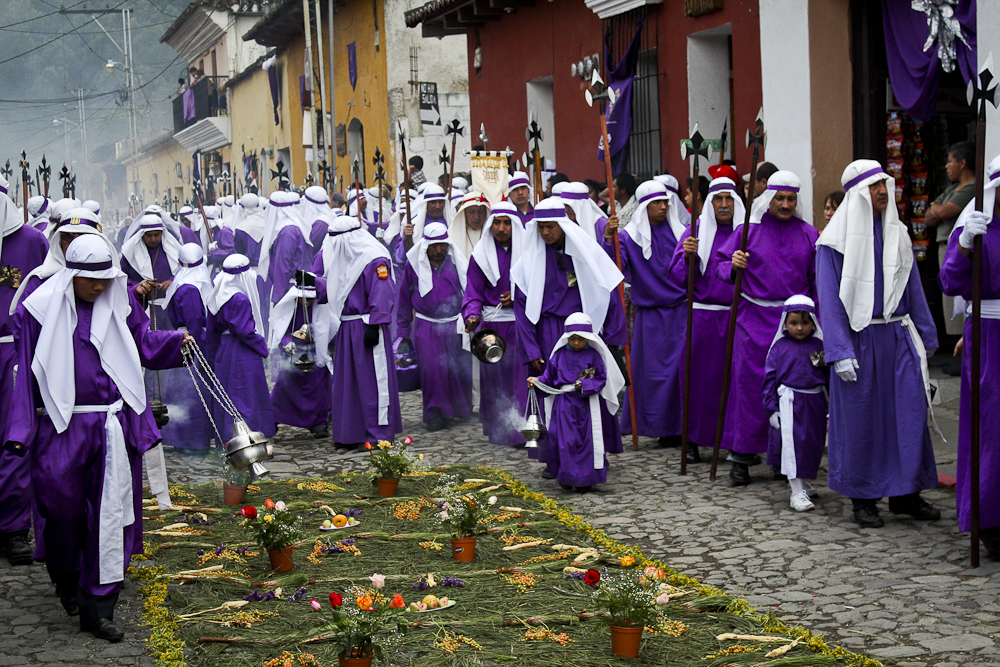
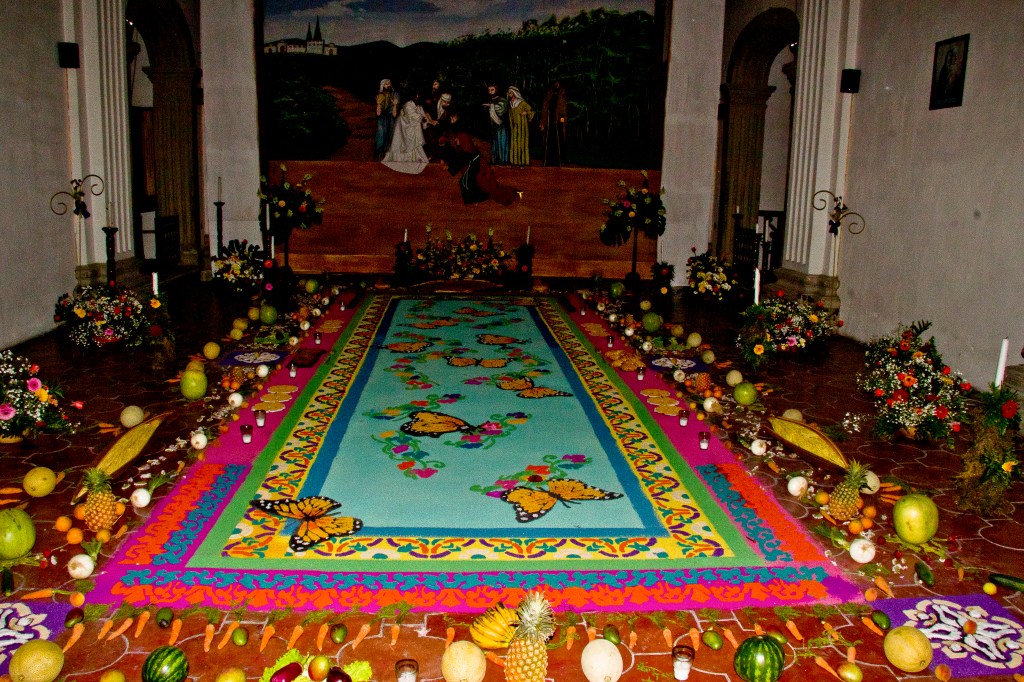
For 50 days, different religious celebrations occur all over the city, culminating in Good Friday. On this day, the city’s streets are filled with incense and covered with sawdust carpets, flowers, and fruit, which the residents make in front of their homes. Preparations begin before sunrise to dramatize the trial and sentence of Christ. Participants dress as Roman and Palestinian soldiers, and the image of Jesus Christ carrying the Cross goes out to the streets on the shoulders of his faithful until the afternoon, when the image of a Reclining Christ takes its place, and the procession of the Holy Burial begins. Antigua Guatemala is filled with mourning. Thousands of people burn incense and dress in black, surrounding the squares and streets.
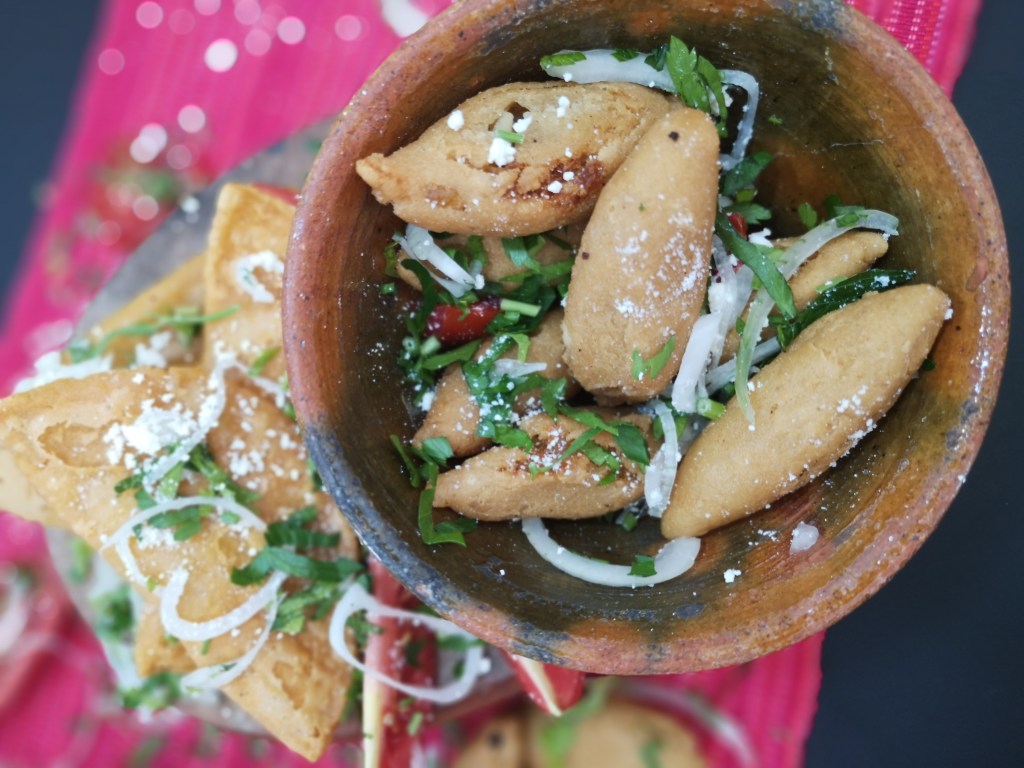
The incense, the music, the colours of the tapestries and unique design gowns, the delicious seasonal cuisine, and the devotion will conquest your five senses, taking you back in time.
Parishioners, neighbors, tourists, artisans, musicians, and authorities participate in the preparations and celebrations, which gives the event its universal and cohesive character.
Pablo Aparicio is an expert on these celebrations, devoted carrier for over 35 years, and past president of the Rescue Jesus Brotherhood in charge of organizing the ceremonial processions. He explains that Lent and Holy Week are a time for reflection, prayer, and repentance. It can be perceived as the perfect convergence of everything that Guatemala offers; it brings together the culture, religion, art, gastronomy, and, most importantly, its people. Whether they are rich or poor, educated or not, no matter what job they have or where they live, during Semana Santa, they are all there, joined by their beliefs and fervor.
Each cobblestone street where numerous processions will go through is covered with temporal tapestries made with flowers, fruits, and coloured sawdust. Each carpet is specially designed as a religious offer and takes months to plan. Families and neighbours get together to create beautiful, block-long, eye-catching designs. This tradition could have been crafted from when Jesus entered Jerusalem riding a donkey, and people received him by placing their coats and palm leaves on the ground for Him to walk on them.
For Aparicio, the part he enjoys the most is the music is the processional marches that escort each procession through their route. “Ninety per cent of them are Guatemalan produced pieces, by local musicians with extensive musical education in marimba and symphonic music.”
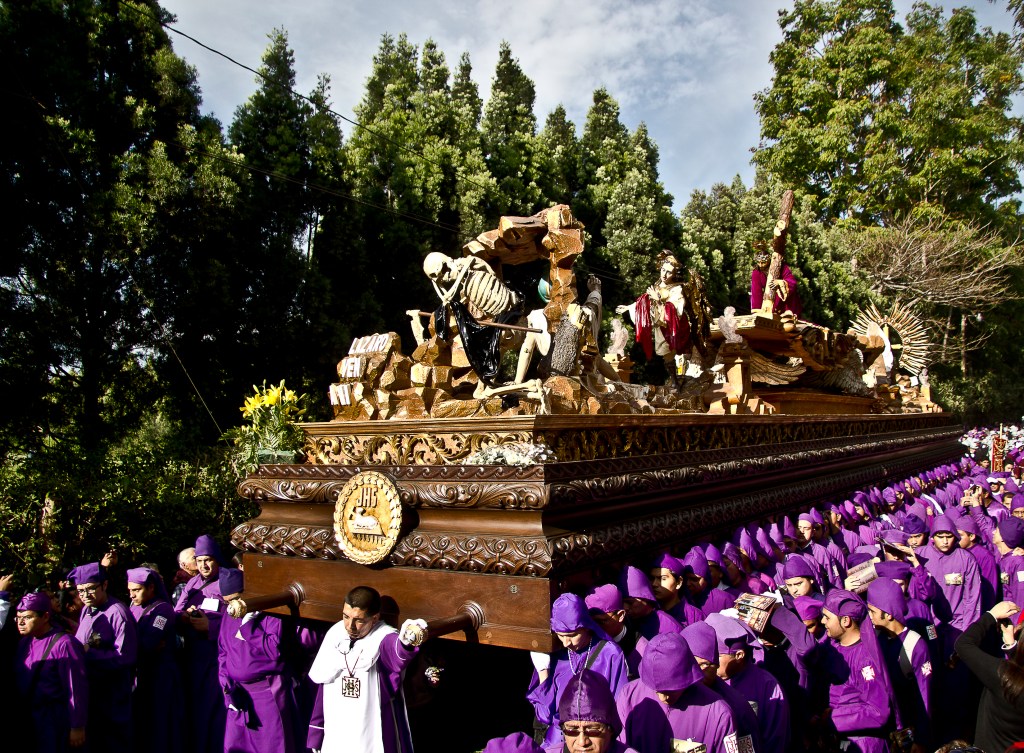
The tapestries, the music, and the food are some of the preparations to honour the processions, which are composed of floats with wood sculptures representing different biblical moments of Jesus’ final days. These processions differ in length and time; they are composed of several wood floats called “Andas” which are carried on the shoulders of the “Cucuruchos”, devoted men and women, as an act of penance and devotion, carrying them for only one block. Then a new shift of carriers steps in to carry them on to the next block. This ritual continues throughout the procession route, often lasting up to 12 hours, leading crowds of mourners who pray in repentance at the beat of the religious music. An awe-inspiring moment to behold is when the floats must turn a corner. Their extended length makes this a logistical achievement. The Cucuruchos initiate a rhythmic pace going forward and backward, led by one driver at the front and several more around the float, who pushes and turns the wood float inch by inch.
“The first float to reach 100 shoulders was called Jesus of Miracles in 1982. Everybody thought it was crazy to make such a long float because it would not be able to turn at intersections,” remembers Aparicio. A very precise team effort between the carriers and the leaders is needed. “Guiding a float is a talent that takes years to master.”
The longest procession is for the Entombment produced by the Calvario Church during Good Friday. It implicates 140 Cucuruchos for the main float, 70 on each side. It has a route of 80 blocks involving more than 18 thousand people between carriers, musicians, leaders, and support staff. The carriers’ shifts are paid as donations to the Church averaging between $2 to $175 depending on the procession’s importance or the shift’s moment. If you were hoping to lend your shoulder as a carrier, probably, you would only get a chance to see the processions from the sidelines, as these shifts are sold-out a year in advance.
Children and women are not left out of this tradition; floats composed of moaning women dressed in black usually carry Virgin Mary and Mary Magdalene. Children’s shifts are also available during daytime processions for smaller floats.
Undoubtedly, Semana Santa has a mysticism that attracts even the most reluctant people, who would not set foot in a Church for Sunday Mass but will do whatever it takes to ensure their carrier shift at their favorite procession. Aparicio explains that the Church recognized this phenomenon as an act of popular piety, where people empathize with Jesus’ suffering and makes it their own.
“Being a Cucurucho goes beyond the religious aspect,” says Aparicio, “it is a responsibility to transfer the traditions and heritage of our culture to the next generations.”
These celebrations contribute more than devotion to the country and its citizens; according to the department of economic studies of the Guatemalan National Bank, the 50-day period that comprehends Lent and Holy Week is a time of greater economic activity in the country, even more than Christmas.
This startling mix of processions, vigils, funeral marches, seasonal cuisine, and the creation of flower tapestries and altars became the most notable event of the small Central American country, subscribed as an Intangible Cultural Heritage of Humanity by UNESCO in 2022. Clearly, a bucket-list experience that you should plan to attend.




Story by Monica Gonzalez. Photos by Chino Estrada.

 Nuup Travel
Leave a comment